"I'm not sick enough yet." I hear that sentence so often, from young people and from adults, from people who have been struggling for years and from people who are only just beginning to notice that something isn't right. I have thought it myself, too. It is one of the most treacherous thoughts within an eating disorder. It keeps people away from help, and it keeps people stuck in the eating disorder even when they do get that help.
A mother said in BUDDY UP: "My daughter was always talking about other girls, saying they were thinner or had been ill for longer. At first I didn't understand why she did that." A young person said about her time as an inpatient: "In an environment with practically only thin people, you feel so fat that it also feels as if you don't belong there and have no right to treatment. I thought I wasn't sick enough because all the others were really thin and I wasn't."
Where does that thought come from? And why is it so persistent?
We learn who we are through other people
To understand that, we need to go back to how a person develops. A child cannot form an image of themselves without the people around them. As early as 1902, the sociologist Charles Cooley called this the looking-glass self: we see ourselves in the mirror of other people's reactions. If someone laughs at my joke, I am funny. If someone looks at me admiringly, I am worthwhile. Later, the psychologist Leon Festinger described how we keep comparing ourselves throughout our lives. We want to know whether we are doing well, and there is no measuring stick for that, so we look at the people around us.
In adolescence, that process becomes especially strong. The developmental psychologist Erik Erikson saw adolescence as the stage in which the big question "Who am I?" takes centre stage. Young people try out different roles, measure themselves against their peers and look for a place where they belong. That is healthy and necessary. But it also makes you vulnerable in those years, precisely because your own inner compass is still under construction.
Who am I? Am I good enough?
Many people with an eating disorder experience an emptiness where their identity ought to be. They ask themselves: "Who am I?", "What is my place in this world?", "Am I allowed to be who I want to be?" and above all: "Am I actually good enough?" If you cannot answer those questions from within, you start looking for the answer outside yourself. In numbers, in achievements, in the way others look at you.
An eating disorder then offers an answer that feels like something to hold on to. I see an eating disorder as a survival strategy, a way of getting a grip when life feels too big. The body becomes the place where you can show that you can do something, that you are strong and disciplined, that you exist. And so that one measuring stick, weight and food, also becomes the measure of your identity.
What secondary gain actually means
In psychology there is the concept of secondary gain: what a condition gives a person, usually unconsciously. I want to be careful with it, because the term sounds as if someone chooses it deliberately or takes advantage of it. That is not the case. Secondary gain is about what the eating disorder seems to give you: care and attention you wouldn't otherwise dare to ask for, an identity ("I'm the one with anorexia"), a place in a group, a sense of control and sometimes even pride.
A father said in BUDDY UP that it is precisely this competition that makes anorexia so different from many other illnesses. Most illnesses you want to be rid of as quickly as possible. With anorexia, it can feel as if you are succeeding at something, and that competition has no final whistle. There is always someone who is thinner, has spent longer in inpatient care or seems "more" ill.
That is why "I'm not sick enough yet" is such a powerful thought. When your illness has become your identity and your place, it feels as if you are only allowed to exist, and only have a right to help, once you do that illness "well enough".
What our own research showed
In 2021, Vermeulen and I carried out research among 155 people aged 14 to 49 who had at some point taken part in group treatment for anorexia. Of them, 148 had come across copying behaviour, and almost a third had had negative experiences with it themselves. The environment was often described as "triggering". Social comparison, the desire to belong to the group and the urge to prove that you are "really ill" came up again and again. Sometimes unhealthy group pressure developed, with people feeling that they weren't really ill if they didn't behave as unhealthily as the others.
That comparing doesn't only happen in treatment groups, by the way. It happens on Instagram and TikTok, at school, on the sports field and in the changing room.
"Sick enough" does not exist
Most people with an eating disorder are not underweight. That is not an exception, it is the rule. Research among young people with so-called atypical anorexia, where someone has all the characteristics of anorexia but a "normal" weight, shows that the physical and psychological consequences can be just as serious as with underweight (Sawyer et al., 2016). So you don't measure your suffering by the scales, and not by someone else either.
There is no threshold you first have to cross to deserve help. Anyone who is struggling with food, with their body or with the question of whether they are good enough deserves to be seen and helped. Now, and not only once it is "bad enough".
Listen further: secondary gain in conversation
In my podcast Eetstoornisvrij door het leven (in Dutch) I offer a holistic view of eating problems and recovery. I made two episodes about secondary gain: a Mind Training to listen to calmly, and an open conversation with someone who has been through it herself.
Follow the podcast on Spotify (in Dutch)

Sick, sicker, sickest: there is no such thing as getting sicker
In this Mind Training I take you to what really lies behind the longing to be thin, and why recovering can feel so frightening. The core message: you don't have to get sicker first to deserve help, because there is no end point at which you are finally "sick enough".
Listen on Spotify (in Dutch)
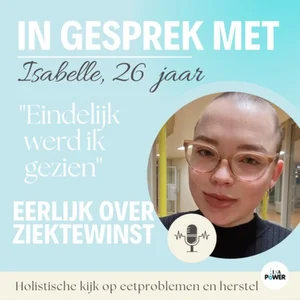
Afraid to let go? Being honest about secondary gain
An open conversation with Isabelle (26), who struggled with secondary gain herself. What if people care more about you since you became ill, and you are relieved of tasks and responsibilities? How do you then find your way back to yourself? About needs, longings and the courage to let go.
"Finally, I was seen."
Listen on Spotify (in Dutch)
What helps
For parents: pay attention to how your child talks about others. When your daughter tells you that other girls are thinner or have been ill for longer, it is often not about those girls, but about the question of whether she herself is allowed to exist as she is. Don't get into a discussion about weight, but ask what she feels when she compares herself. Don't make comparisons yourself either, not even with good intentions.
For professionals: take the feeling of "not being sick enough" seriously, especially in people who look physically reasonably well. In groups, be alert to comparing and copying, without shaming people for it.
And for you, if you recognise this thought: you don't have to prove yourself to be allowed to ask for help. Recovery doesn't mean losing something that was your identity. It means discovering who you are without that one measuring stick: your humour, your sensitivity, your dreams, the things that make you happy. That question, "Who am I?", deserves a much richer answer than a number.
You are not "not sick enough". You are enough.
Further reading
- Hierarchy, copying and comparison in eating disorders: the illusion in our own heads (in Dutch)
- Recovery is for every body, even if you look "healthy" (in Dutch)
- Bulimia without being underweight: why can't you always see an eating disorder? (in Dutch)
Isabelle Plasmeijer
ISA Power offers specialist support with lived experience, alongside regular care; we are not a clinic and do not replace medical treatment. This article was originally written in Dutch: read the Dutch version.